Study Session 4
Nov 6, 2026
Now, does Aristotle consider the soul to be the organisation of the body?
This is Heinaman’s next key question.
The organisation of the body enables an organism to engage in certain types of behaviour.
Heinaman: in De Anima 1.4 Aristotle argues that the soul is not the organisation of the body.
Which Ancient Greek word (translated) would Aristotle use if he did think that the soul is the organisation of the body?
Arrangement
Mixture
Proportion
Combination
State
Condition
According to Heinaman, the first word does not appear in the De Anima - but the next four do.
There, Aristotle argues that the soul is not a mixture, proportion, or combination of bodily parts.
Heinaman then teases out these distinctions:

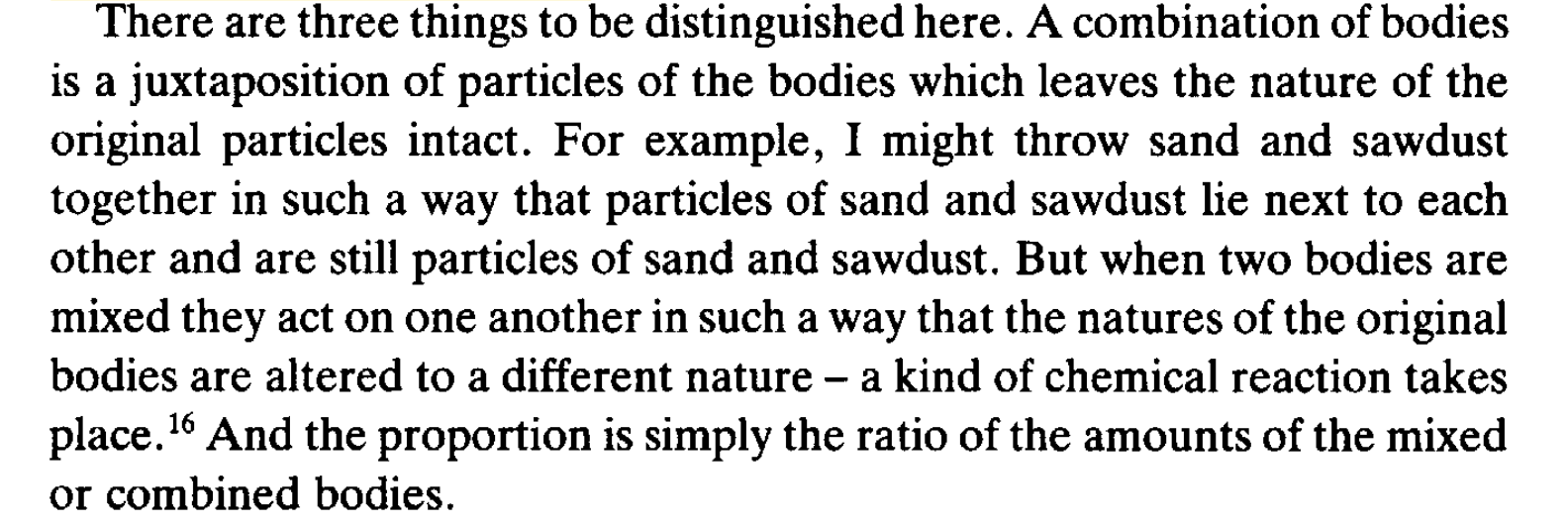
Heinaman vehemently defends Aristotle’s corner: it is useless to appeal to any of those notions as to the identification of the soul.


Prior, Heinaman highlights Aristotle’s argument that health, or other bodily virtues, *can* be identified with a harmony of bodily parts.
A state is defined as an arrangement of what has parts; a condition is a kind of state, and health is one such condition.
Health is an arrangement of bodily parts, a condition, and a state of the body.
But the view that the soul is some organisation of the body is false.
If the Body Paints the World Inside itself, What Paint Does it Use?
Nov 5, 2026

"Knowing that all things have their emanations" - Empedocles, 5th century BCE
Organic Growth
Nov 2, 2026
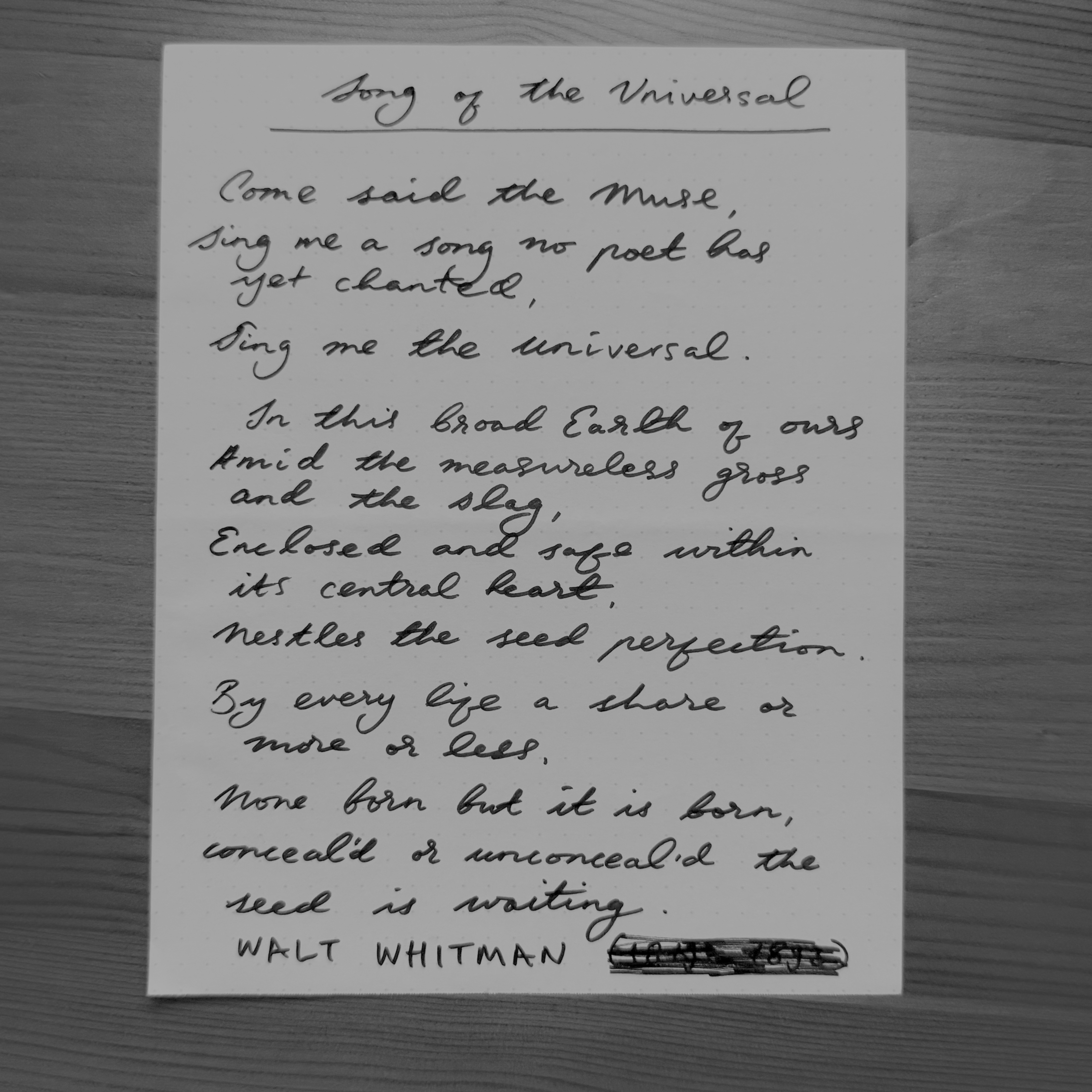
I've been meaning to read Walt Whitman's poetry for a while. While leafing through a copy of his complete poems, I was reminded what a giant of literature he was.
Study Session 3
Oct 30, 2026
It should be stated outright that Aristotle was a dualist with relation to the mind-body problem (Aristotle's position, as noted by Burnyeat 1995, is difficult to cohere with modern, Physicalist ideas).
So what does this entail? Heinaman is explicit: Aristotle must believe that the soul is an immaterial entity.
And what is the meaning of immateriality? For the soul to be an immaterial entity, it cannot be made of matter.
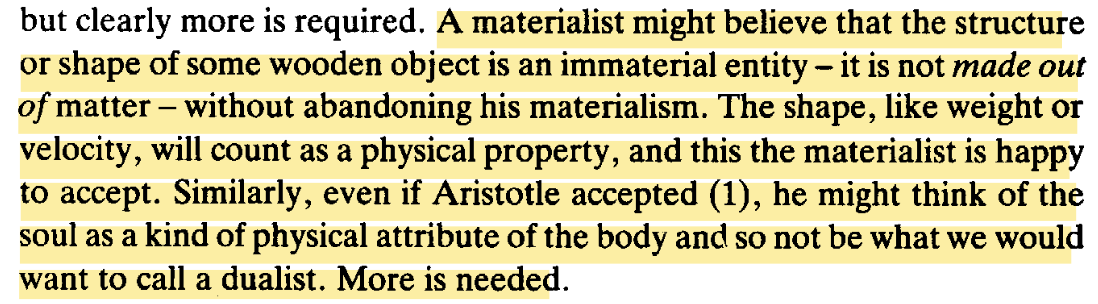
But this is qualified since a materialist can still accept the presence of immaterial properties in an object without abandoning his materialism:
In the last note, I ended at Heinaman's claim that for Aristotle the soul is changeless because it lacks magnitude. Questioning this, Heinaman now writes:
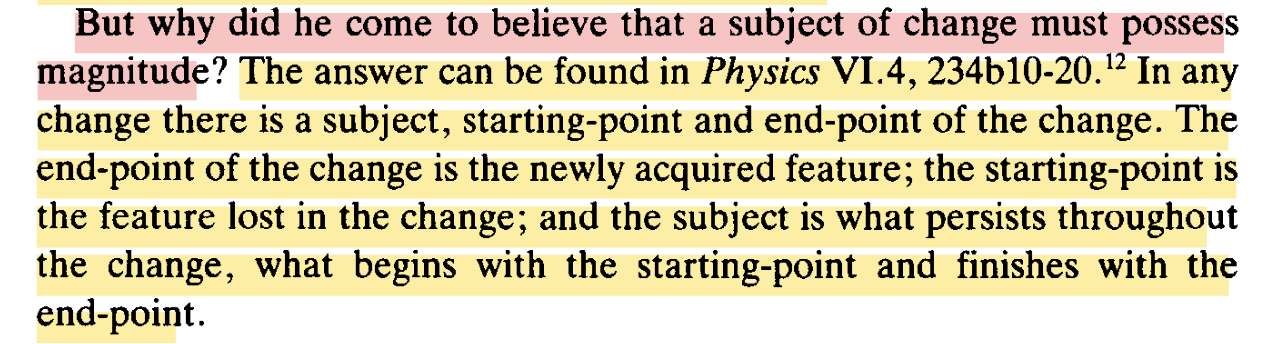
Aristotle's argument is the following: If a subject is changing from A to B (A is white and B is grey), B being the first thing the subject changes into, he cannot be in A for the whole, nor in B for the whole. If he is in A for the whole, then he is at the starting point of the change. Nor can the subject be in B for the whole because the subject would have changed and not be in the process of changing - becoming B.
The subject must partly be in A and partly be in B. But this entails that the subject of change is divisible into parts. But the soul is a form, and forms are indivisble, the soul is changeless.
And since Aristotle believes all matter is divisible and changeable, the soul is therefore immaterial.
And since Aristotle considers the soul to be a substance, the soul is an immaterial substance.
Study Session 2
Oct 29, 2026
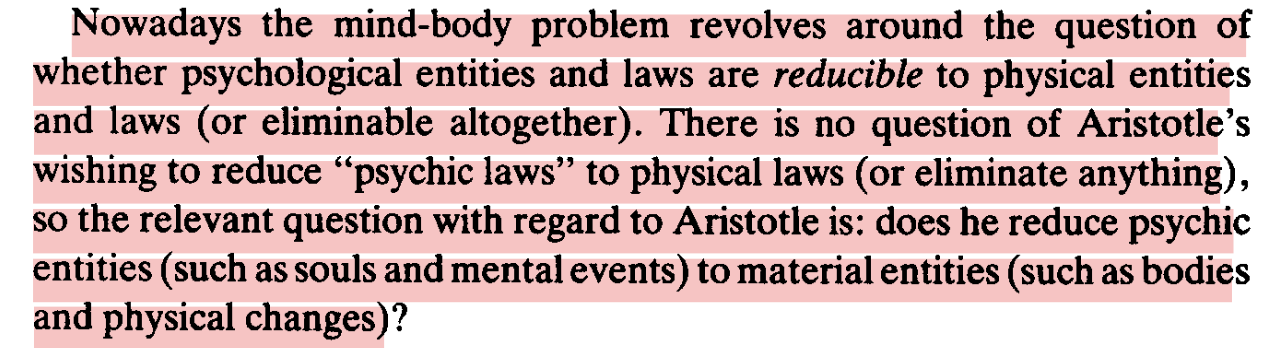
Perhaps it might be better to begin with the name of this paper, the question the author puts forward, and his main claim.’ Aristotle and the Mind-Body Problem’ is a paper by Robert Heinaman published in the journal Phronesis in 1990 (Vol. 35: 1), pp. 83 - 102.
The author’s main question, as stated on p. 84, is as follows:
And his claim (from page 1):

What is the historical angle here? Heinaman cites Democritus, the first atomist, who claimed:

Aristotle had claimed that the living and non-living are distinguished by the fact that the former possess movement and perception. And since it is the soul which distinguishes the living, the soul explains why living things are able to move.
But Aristotle’s agreement is only partial; he agrees that the soul of a living thing explains why it moves, but rejects the mechanism proposed by Democritus.
The reason for Aristotle’s rejection of the proposed mechanism I mention earlier in my study session 1 note: “…because the soul is a form, and all forms are immaterial, and hence changeless”.
In writing the Physics, which came prior to the De Anima, Heinaman claims Aristotle altered his position on whether the soul undergoes change: “There we find a rather strange intermediate position where some but not all transitions between different qualities of the soul are changes”.
What characterises Aristotle’s earlier intermediate position is that the soul only undergoes perceptual change:
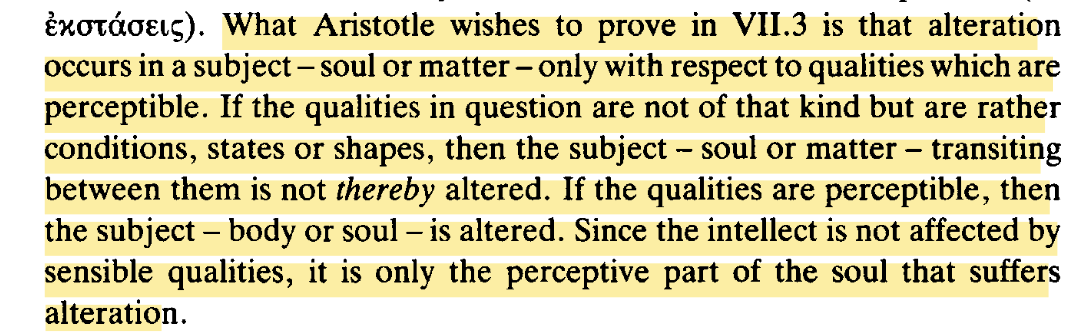
So when Aristotle wrote the De Anima, Heinaman highlights that he likely had thought out the issues prior to reaching his mature conclusion:

Study Session 1
Oct 29, 2026

Heinaman’s claim here is that Aristotle rejects the idea that the soul undergoes change, because only material things undergo change.

Interesting.

This seems right.
Follow your Intuition
Oct 28, 2026
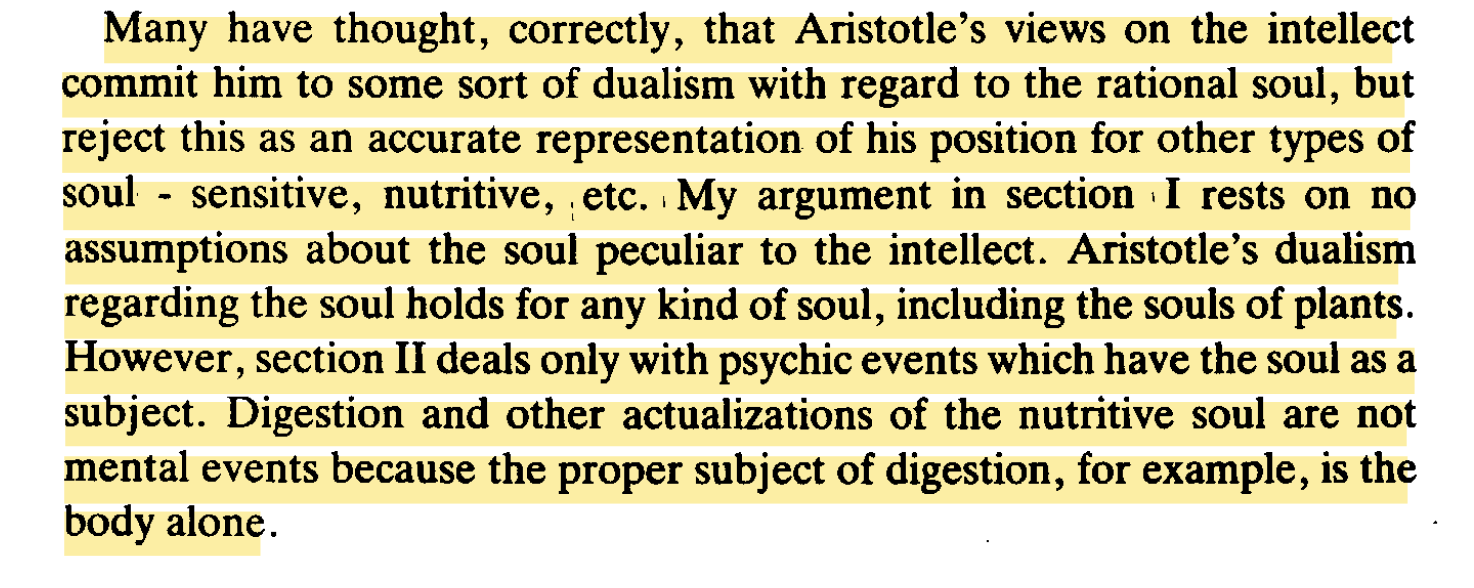
I don’t want to read this Aristotle paper - but I will. Because whenever I pass on something that I should have followed - but I return to later instead - I always find something valuable there.
Probably somewhere in this paper there's one line or one idea that will link up a series of disjointed ideas I have from other papers, and give them a road to communicate through.
Books from Yesteryear
Oct 28, 2026
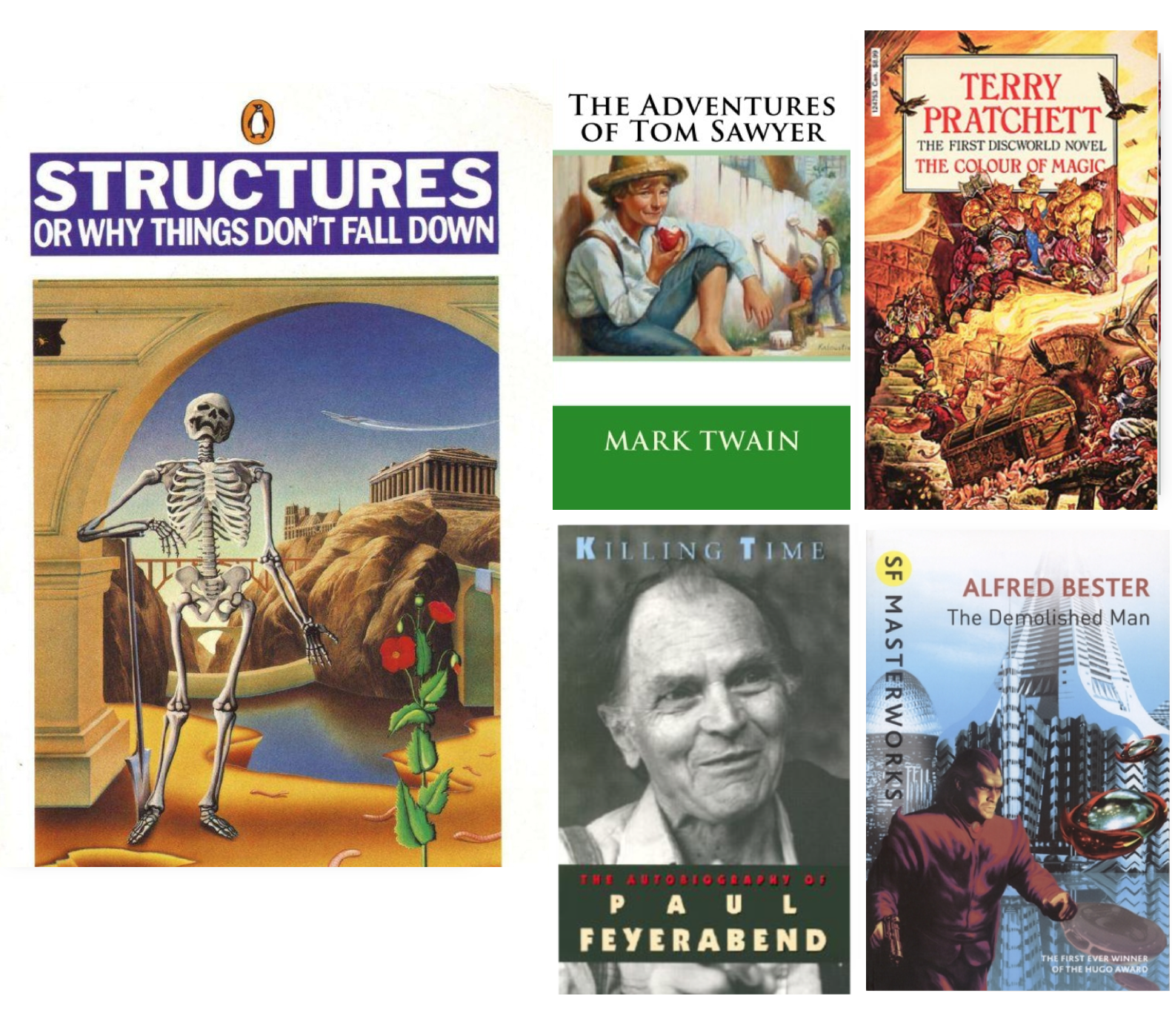
Throwback to the books I was reading in 2019. Structures, The Autobiography of Paul Feyerabend, and The Colour of Magic made a huge impression on me. Especially Feyerabend’s autobiography; it’s so full of warmth and interesting anecdotes. What I also found especially interesting was my compassion towards him, despite him having been conscripted in WWII to fight for the Nazi's.
Structures is a surprisingly simple book, but it has a lot of depth. It changed my whole outlook.
Not much to say about The Colour of Magic - it’s a book that has to be experienced. I genuinely couldn’t believe how good it was.
Abilities
Oct 27, 2026

When I was a kid, I used to watch Dragon Ball Z - an anime show about Goku, his friends, and their enemies. Goku is an interesting character - and there are some others besides him which are also interesting - because he’s an incarnation of the Holy Fool archetype.
Anyway, I mention all of this because in one of the games I used to play on the PlayStation 2, Trunks, one of the characters, says in the duelling section, "I’m here to test everyone’s abilities". For some reason this really speaks to me.
Maybe it’s because lately I feel like I’ve reached the limits of my abilities and I need to find a new path forward. It's tough...
Wladlyslaw Reymont
Oct 27, 2026
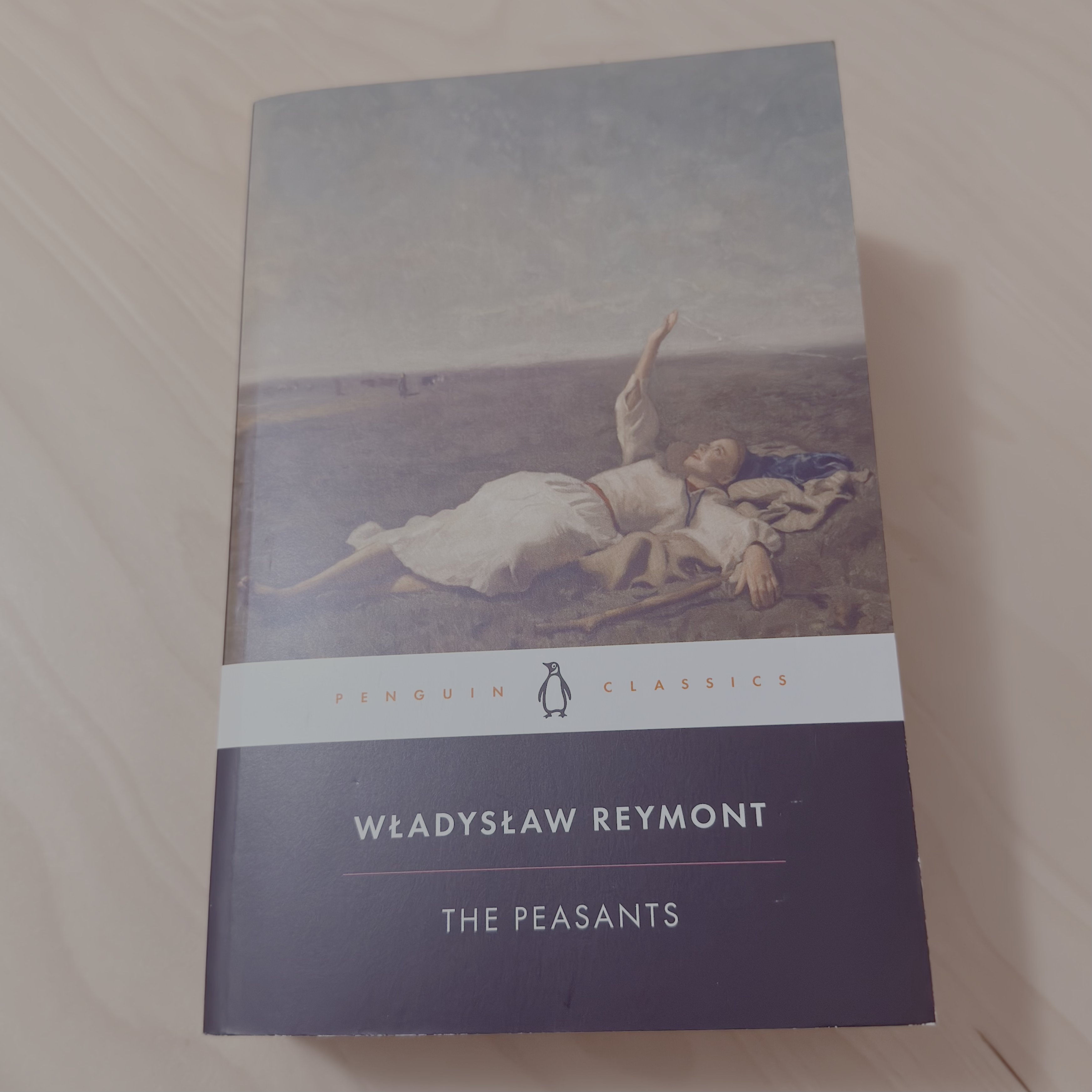
Recently I was looking at a list of books by Nobel Prize winners in Literature, and was debating with myself as to which one to get. But then I realised that’s not a complete list!
So after scouring Wikipedia, I bought The Peasants by Wladyslaw Reymont, who won the Nobel Prize in Literature in 1924.
Learning in the Age of Agentic AI
Oct 19, 2026
I wanted to write a note about how I use agentic AI for learning. First because it’s novel (to me at least). And second in the hope that someone else finds it useful.
I use OpenClaw – an agentic AI harness – that I connect to Anthropic’s Claude using metered intelligence via their API.
The process takes about an hour to set up (with help from AI), and now I’m able to chat with OpenClaw using Discord (WhatsApp, iMessage, etc, are also available). Using just my phone, I can write files to my computer, request files, move them, and so on.
First I’ll tell you about my reading process. I’m basically old-fashioned: I print things out, I underline important passages with a pen, I write marginalia notes, questions, and I make arguments as to whether I agree or disagree with the claims being made in the paper or book that I’m reading. In between, I take long walks to think about ideas, what they mean, how they might connect to other ideas, or how they fit into my broader worldview.
Once I make my initial pass, I add highlights and notes into the digital version of the paper on Zotero. But since human memory is not optimised for memorisation, this note-taking process tends to break down.
In 1885, the psychologist Ebbinghaus showed us there is a ‘forgetting curve’ – within a day or so after you learn something, your recall will drop significantly. This process continues unless something is done to reverse it, to ‘flatten’ the curve.
Later, spaced repetition was developed as a way of slowing down the forgetting curve. You review information at increasing intervals (e.g. 10 minutes after, then at 1 hour, then 1 day, then 1 week, and finally 1 month).
This is where agentic AI comes in. Once I read a paper, I drop it into my Discord chat with OpenClaw and ask it to quiz me on the paper using Anki-style questions. Here’s an example exchange:
OpenClaw:
“In De Anima II.5, Aristotle describes the move from having knowledge (first actuality) to exercising it (second actuality). Is this an alteration in the strict sense? Why does that matter for Sisko’s argument?”
Me:
“It is not an alteration in the strict sense. Aristotle claims it is not an alteration, or it is an alteration of a different kind to that of material alteration. It matters for Sisko’s argument, that material alteration is necessary for thought and perception, because it raises doubts about proposed claims in the literature that DA II shows that material alteration is not involved in perception.”
OpenClaw:
“Correct. You’ve got the main point: the move from first to second actuality isn’t an alteration in the strict sense (it’s more a perfecting or fulfilment). Your explanation of why it matters is also good. Some scholars take De Anima II to show that perception doesn’t involve material alteration, and Sisko wants to block that inference.
I’d tighten my own card to match your wording, because it was muddled. I’m marking it correct.”
And then on to the next question.
Using metered pricing, this process averages to about 10p per question. You could of course use an LLM through a web interface, but I personally like having the option of being able to point the agent to the PDF file in its sandbox directory.
In addition, my review questions and answers are saved automatically, and OpenClaw messages me at spaced intervals.
All in all, I’m very impressed with how well it works, and I’m excited to see how I can further leverage agentic AI to learn, while still retaining my good old-fashioned methods of working.